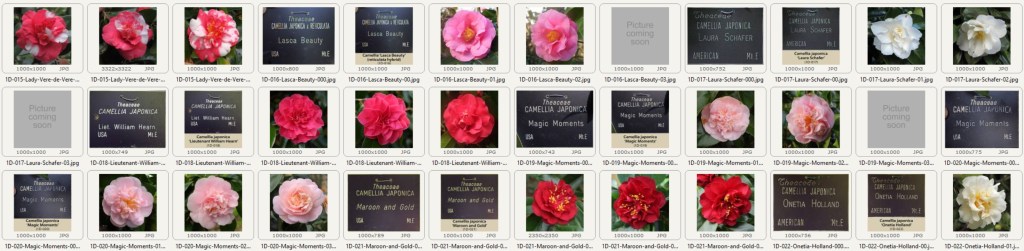
I’ve just spent several weeks working my way through the Mount Edgcumbe collection records to bring them up to date. I have done much the same with the galleries of pictures under the Mt Edgcumbe tab on this website. For most sections of the collection I have added another column of images, so that each plant has three, hopefully providing a better idea of the range of blooms that each has produced over the years I have been photographing them.
The records for the collection are now kept on the Plant Heritage online database system, Persephone, which is not open access. The main statistics for the collection in Persephone are:
Number of Taxa: 882
Number of Cultivars: 869
Number of species: 51
Number of Accessions: 1638
The last figure is not the sum of the previous three because there is more than one accession for many taxa and species can have many cultivars.
The database actually contains 1782 records and the figure of 1638 accessions is the number of plants the status of which is “alive”. There are unfortunately 40 where the given status is “dead”. Most of these have died since I started putting the data onto Persephone, some slightly predate it.
A further 102 have been given the status “excluded” because I don’t know what they are. When I started working on the records there was only one plant that was neither labelled nor marked on any of the plans. All the others were named, but not neccessarily correctly. The 102 represent the ones that I am convinced are wrong but haven’t been able to identify so far. I may have an idea what they are but am not certain enough to put a label on them and change their status.
There are, no doubt, plenty of others that are labelled incorrectly which I have not identified as being so. If someone hazards a guess at the name of a plant, the guess will usually either be correct or will be something similar. Many of the varieties I have relabelled have been labelled as varieties that might be described as good guesses. Wrong, but I could understand why they’d been given the name they had.
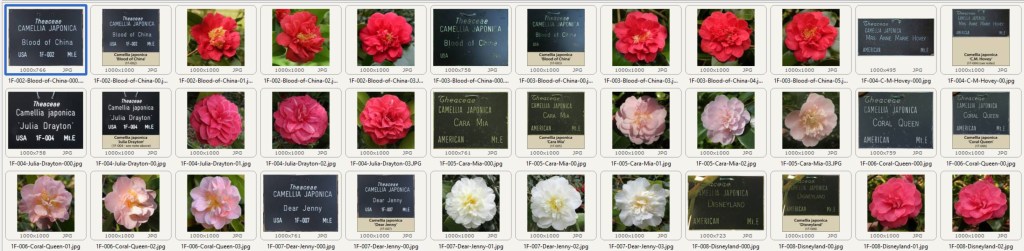
There is a tab above for “idents needed”. That is the beginnings of getting full descriptions of all the excluded varieties onto this site in the hope that suggestions will be forthcoming for their identity. It will not be easy. For example, in section 1A there are two plants labelled ‘Auburn White’. They are quite different from a plant of ‘Auburn White’ in section 1H, which I believe to be correct. I think they may be ‘China Doll’, which there is a plant of in Section 1K but side by side comparison of both flowers and foliage still leaves room for doubt. It is probably just down to very different growing conditions but it makes the point that even when I have pieces of two plants side by side it can be hard to be sure, never mind trying to identify it from a poor picture of a single flower that grew on a bush in a climate very different from here. Or a short description with no pictures.
That figure of 102 excluded hasn’t changed much. As fast as I get it down by finding a name for one plant, it comes to my attention that another is wrong. I have renamed just over a hundred plants; sometimes they were understandably wrong (the good guesses), sometimes incomprehensibly wrong, sometimes recognized synonyms, sometimes probably rootstocks and so on.
It probably isn’t hugely important in the great scheme of things but it seems to me that a national collection should serve as a reference collection as well as a genetic reserve. A reference collection isn’t much use unless it can be referenced, and that for most people cannot be a visit to the physical collection. The purpose of this record is to make it more widely and easily accessible and to fill in some of the gaps represented on the ground by plants with no more than a number to identify them.
It’s a work in progress, and always will be.

 Jim's Camellias
I did a hard cut back of two camellia trees that had grown taller than the house. First time doing it. Is it ok to do it in mid January
LikeLike
Should be fine. People usually leave them until after flowering but only so they get the flowers rather than chopping them while in bud. February/March is generally the best time to prune evergreen shrubs but going a month earlier isn’t likely to make much difference. In a much colder climate than the UK I’m less confident and would advise having a chat with someone knowledgeable locally.
LikeLike
I am in Australia where we are in the middle of summer
LikeLike
That would be equivalent to July here, which I would regard as late but mainly because of the risk to new growth of frost in the following winter, which is probably not an issue for you. Stirling Macoboy, an Australian author, says in his book not to do hard pruning any time other than late winter, so there may be other issues that apply where you are that I am unaware of but I’m struggling to think of anything that will be very serious, let alone fatal.
LikeLike