My second filming trip to the park this autumn was on November 10th. In spite of weeks of wet and windy weather, the camellias were putting on a respectable show. Some of the earliest flowerers, like ‘Hugh Evans’, ‘Plantation Pink’, ‘New Dawn’ and ‘Baronesa de Soutelinho’ were past their peak but plenty of others had opened up to keep the display going.
Every year I find myself revisiting nomenclatural conundrums that had been shelved a year ago when the flowering season for that variety had passed. Sometimes I have in the intervening months been looking closely at foliage, timing of new growth and other potential diagnostic features. Sometimes I have formed an opinion about what a variety might be and am just waiting for it to flower again to make absolutely sure before I go ahead with changing a label.
One such is a plant labelled ‘Sparkling Burgundy’, which I am now convinced is in fact ‘Showa-no-sakae’. When I first started working with the collection there were two plants labelled ‘Sparkling Burgundy’. One of these revealed itself to be ‘Hugh Evans’ on the first occasion I saw it in flower. The other I was less sure about but I was forced to put aside consideration of its identity when a tree fell on top of it and reduced it to a stump just a couple of feet tall. It didn’t flower again for some years and the first flowers were perhaps not typical, but now it is back to performing well and I was told a year ago that it was not ‘Sparkling Burgundy’ but probably ‘Showa-no-sakae’.
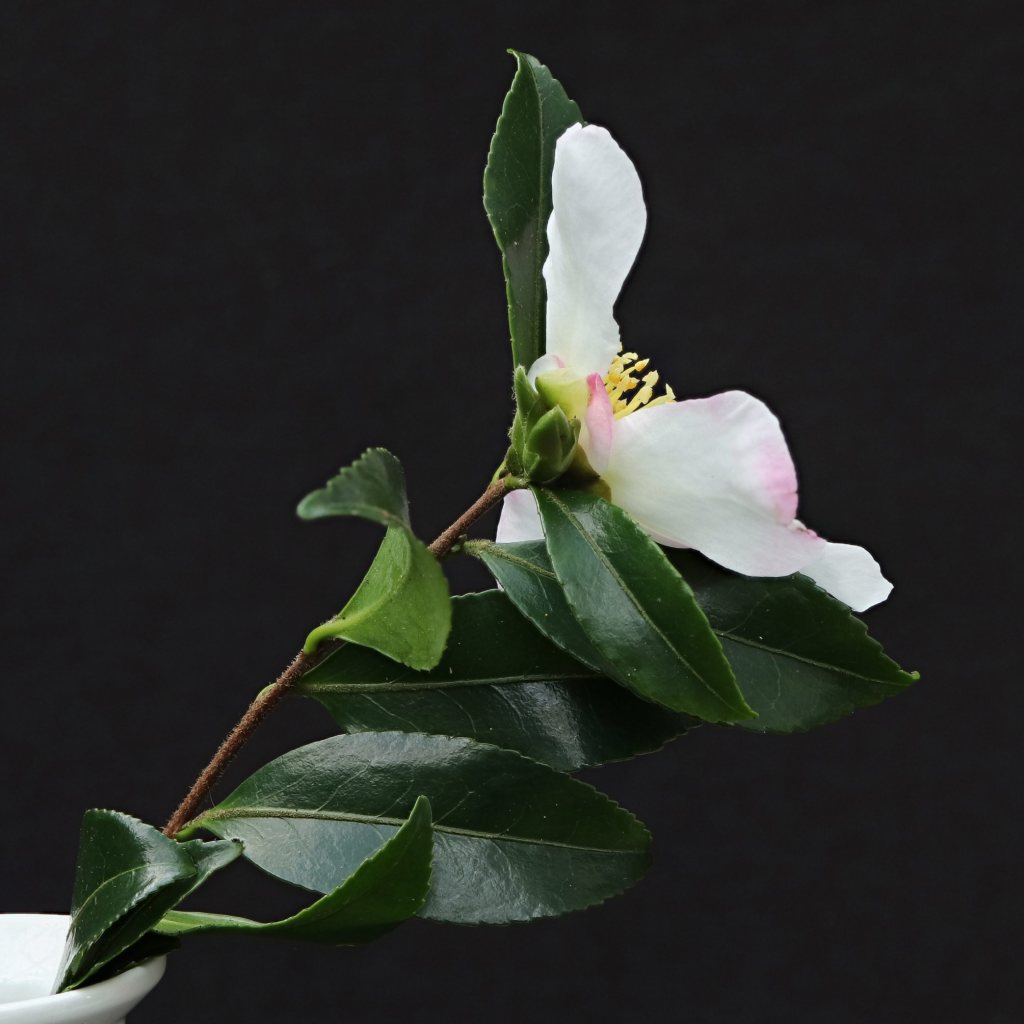
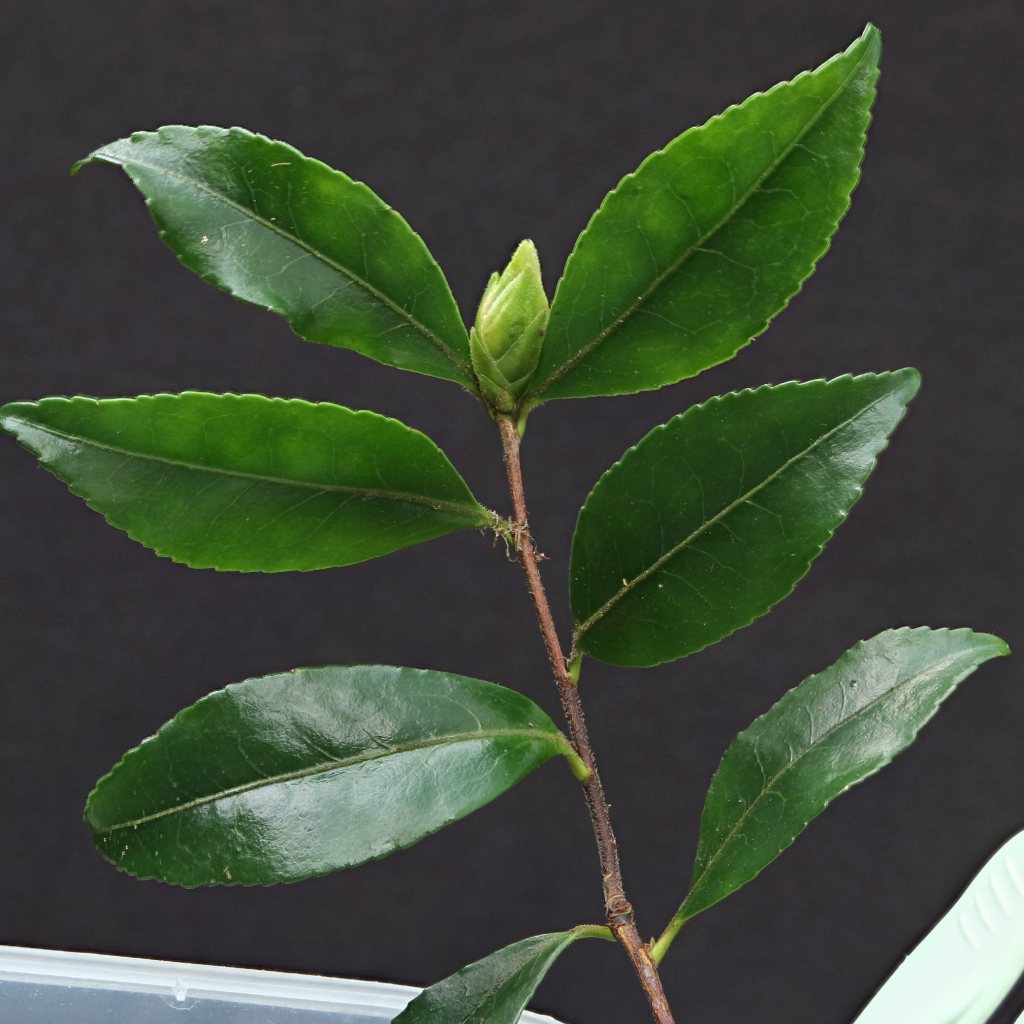
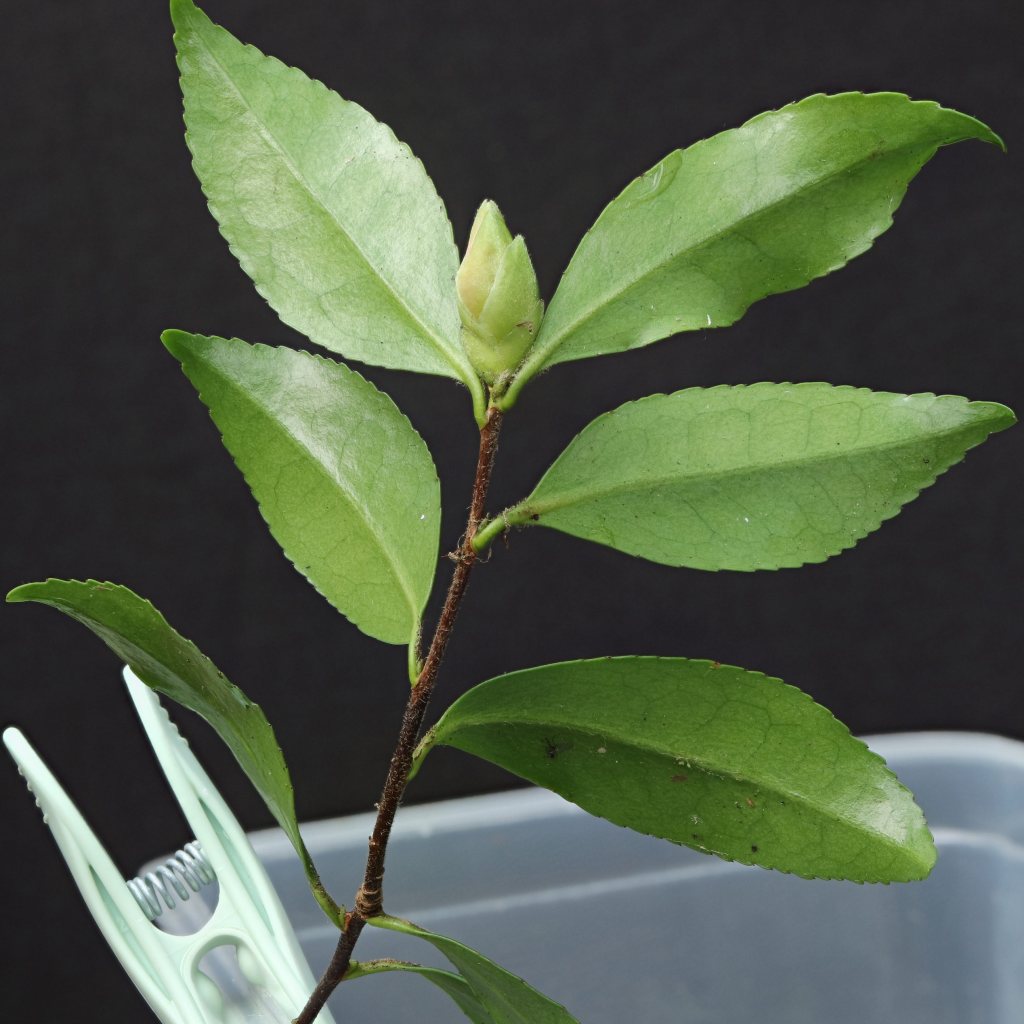
Another mystery plant in the same area is a single white sasanqua not unlike ‘Rainbow’. There are several plants of ‘Rainbow’ nearby and I have no particular reason to doubt that they are accurately named; this one, 10-078, is different. It flowers earlier, the flowers are smaller, with narrower petals and they last only a few days before shattering. It also has narrower leaves than ‘Rainbow’. I brought a few shoots home and took a series of images of it. If it looks like something you know, can you make a very careful comparison and let me know if you think you know what it is.
It flowers mid October to late November, perhaps two or three weeks ahead of Rainbow. It is a wide spreading bush, much wider than high, but looks like it may have fallen over in the past, so it may make an upright bush in the right conditions.
An “average” leaf is 60-65mm long, 21-24mm wide. The largest are about 72 x 25mm. The leaf blade has a long taper to the petiole, leaving 5-7mm clear to the stem.


 Jim's Camellias
Dear Jim Great pics, enjoyed very much!
two notes: 1- Dona Jane Andreson has fimbriated petals, as Fimbriata.
2-As you mentioned, ‘ Augusto Leal de Gouveia Pinto’ do not exhibit these flowers. But the country is also wrong – this is a Portuguese cultivar, one of my favourites. I visited the mother plant some years ago in Centre of Portugal.
[image: Camellia japonica ‘Augusto Leal de Gouveia Pinto’] https://jimscamellias.com/mt-edgcumbe/area-5c-european/5c-002-augusto-pinto-00/Camellia japonica âAugusto Leal de Gouveia Pintoâ (5C-002)[image: Camellia japonica ‘Augusto Leal de Gouveia Pinto’] https://jimscamellias.com/mt-edgcumbe/area-5c-european/5c-002-augusto-pinto-01/[image: Camellia japonica ‘Augusto Leal de Gouveia Pinto’] https://jimscamellias.com/mt-edgcumbe/area-5c-european/5c-002-augusto-pinto-02/
Best Regards, Eduarda Paz [image: CaminhosOcidente.jpg]
LikeLike
I’m slowly working my way through the whole collection updating things like the incorrectly named ‘Augusto Leal de Gouveia Pinto’ but I’ve only reached section 1L so far. As I suggested, that particular plant turned out to be ‘Adolphe Audusson’ and has been relabelled accordingly. ‘Dona Jane Andreson’ should be fimbriated and neither of the two plants here are. The next question then is whether they have reverted back to ‘Doutor Balthazar de Mello’, from which the variety sported, or are they something else entirely. I am beginning to think they may be ‘Julia Drayton’; they seem to match very closely on flower appearance and timing, on foliage and on the timing and appearance of new growth. What I am doing in these circumstances, i.e. I know the name on it now is wrong but I don’t know what the correct name is, is to replace the name label with just a number until such time as I am sufficiently certain of its identity.
Thank you very much for your comments, it’s especially helpful to get input from people in the countries where these things were raised and where they are probably much more widely grown. I rarely have anything to compare the more obscure varieties with.
LikeLike