A new camellia season is well and truly under way so it’s time to put finger to keyboard and bring you up to date on the state of play in the national collection at Mount Edgcumbe.
I don’t go up there very often in the summer; nothing is flowering, the grass is long and the ticks are active. Now we’re into autumn, the grass has been cut, autumn flowering varieties are beginning to flower and having had a pretty wet summer, conditions are ideal for planting.
While there are no plans for major plantings this year, I have had a number of things that I have been growing on for a few years until they are big enough to withstand the rigours of park life. So far I have planted C. sasanqua ‘Cleopatra’, C. japonica ‘Dark of the Moon’, C. ‘Patricia Short’, C. sasanqua ‘Exquisite’, C. ‘Jinhua Meinü’ and C. yunnanensis. Next week should see the addition of C. sasanqua ‘Sasanqua Variegata’ and C. sasanqua ‘Paradise Gillian’. Not huge numbers but enough to more than offset the year’s casualties, so going in the right direction.
When I visited the collection on 1st October, I found just one camellia flower out, C. ‘Snow Flurry’, which had a single bloom that shattered when I tried to get its photo. By the middle of the month I was able to photograph 5 varieties and on the 22nd I took pictures of 12.
One of the twelve was C. ‘1001 Summer Nights Jasmine’. This was the much hyped summer flowering hybrid between the recently discovered Camellia azalea, aka Camellia changii, and C. ‘Dr Clifford Parks’. If I haven’t said it before, I’ll say it now, I’m deeply sceptical about the back story to this variety; at the very least there has been a mix up resulting in several different clones being supplied under the name. This particular plant is the one that was on the plant of the year stand at the Chelsea Flower Show in September 2021. It has a single flower with up to 7-9 petals and I suspect it is not hybrid at all, but the species C. azalea. I have seen other C. azalea hybrids, in the flesh and in photographs and they are very obviously hybrids, whereas this form looks like all the pictures of C. azalea that I have seen. That said, when plants of C. azalea first appeared in the west it rapidly acquired a reputation for being difficult to grow, which this plant seems not to be.


‘1001 Summer Nights’ is in the species section 10, along with several autumn flowering C. sasanqua varieties. There are species here but also many cultivars. C. sasanqua ‘Plantation Pink’ is represented by two large plants, both of which flower reliably if not especially freely. Raised in Australia it perhaps would be better in a hotter climate. C. sasanqua ‘Hugh Evans’ was raised in America from seed imported from Japan and there are six plants of it in the collection. Those in more open situations flower much better.
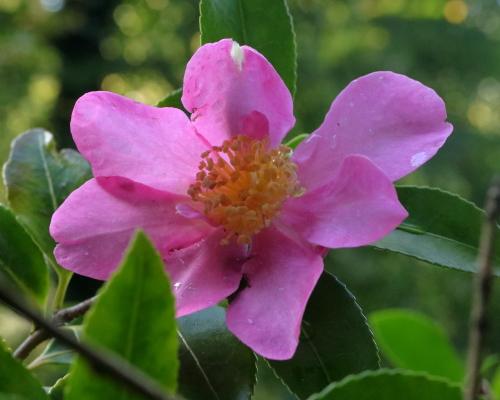
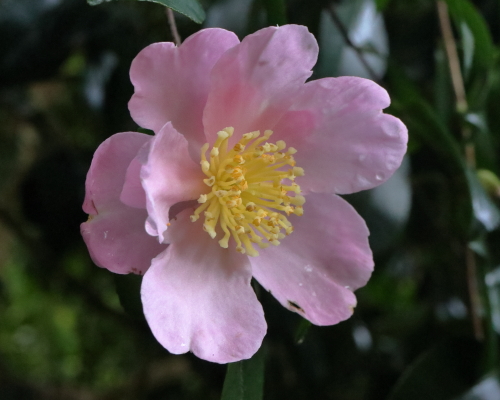
The plant with the most flowers out now in section 10 is C. hiemalis ‘Dazzler’. As is often the case when a variety stands out from the crowd, it turns out to have been raised by Nuccio’s Nursery in California. I find it tricky to accurately capture the somewhat strident magenta colour that this and many other hiemalis varieties share. C. hiemalis ‘Showa-no-sakae’ is a less strident colour and has been the cause of another familiar problem. It was obtained as, and for many years labelled, C. ‘Sparkling Burgundy’. I am now persuaded that it is ‘Showa-no-sakae’, from Japan. Sadly, none of the three plants in the collection that were labelled ‘Sparkling Burgundy’ have turned out to be that variety. One was ‘Hugh Evans’, the other two are both ‘Showa-no-sakae’.

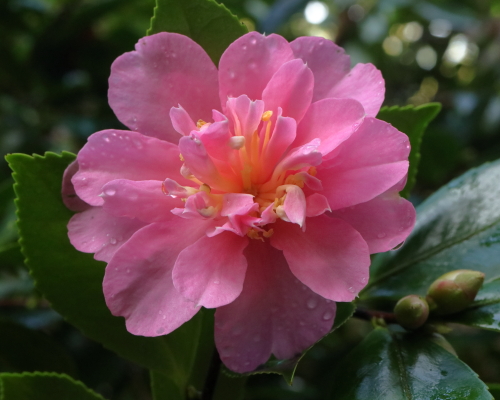
Moving down to the lower amphitheatre area, there is a Japanese section with a large bush of C. sasanqua ‘Setsugekka’ flowering at the front. Just across from it another white flower is partly open, the small, funnel shaped and sweetly scented C. ‘Shiro-wabisuke’. Some authorities have raised wabisuke to species rank but the more general view is that it is a form of C. japonica.
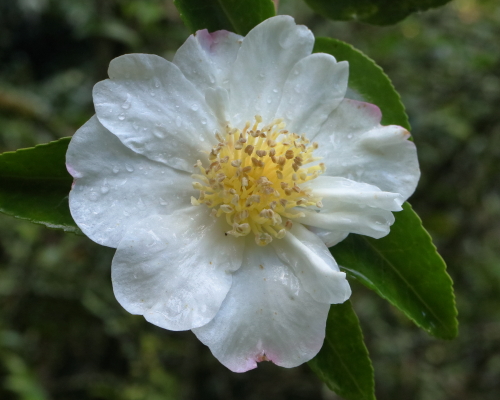
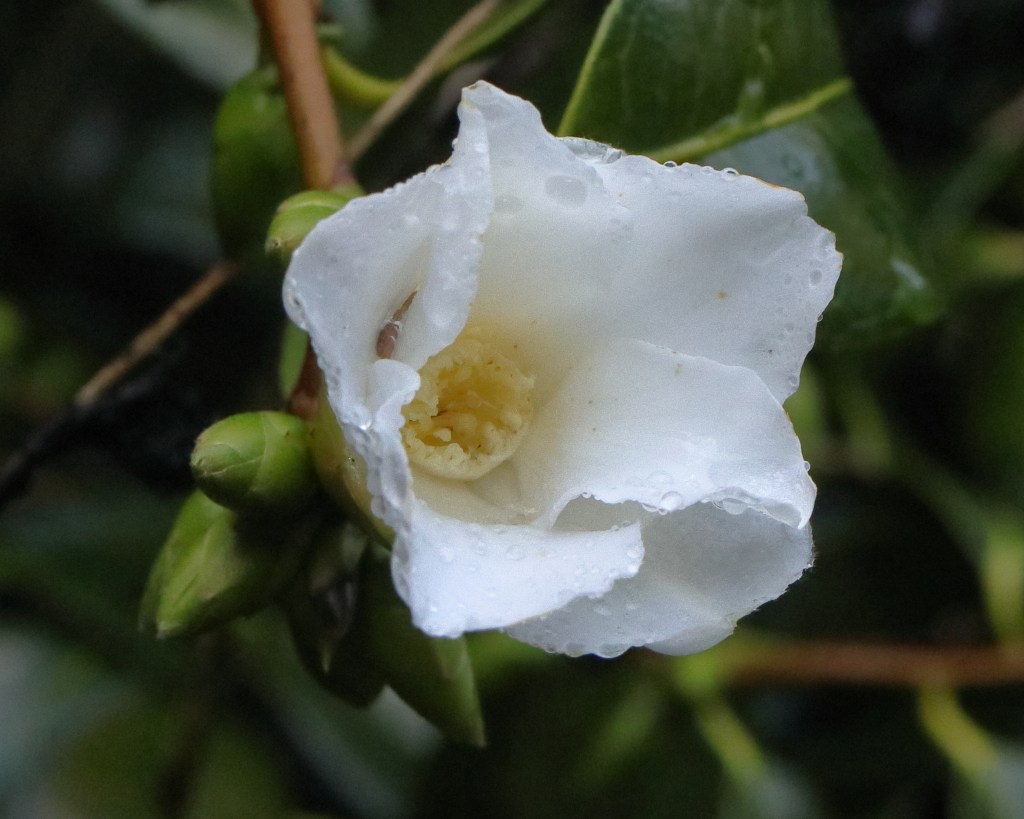
Section 1L, half way along the lower amphitheatre, has several of William Ackerman’s very hardy varieties growing along the higher back path. A very large beech tree fell down some years ago, letting sunlight in practically all day long where before there had been complete shade. C. ‘Snow Flurry’ and C. ‘Winter’s Charm’ are among several varieties that now flower freely where they had previously barely flowered at all. ‘Snow Flurry’ is a somewhat rangy, large bush; this plant of ‘Winter’s Charm’ is compact and a domed mound of almost weeping branches. ‘Snow Flurry’ had plenty of flowers out, mostly out of reach of my camera, ‘Winter’s Charm’ had only a couple of flowers open. The latter is one of a relatively small number of camellias in the collection that reliably produces fruits and seeds each year. For many years it was mis-identified and labelled as ‘Winter’s Rose’.


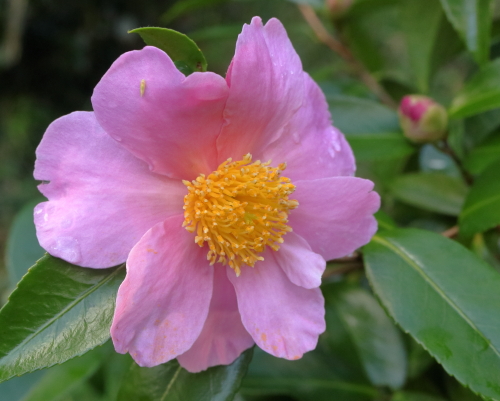
Last and by no means least was a bush of C. ‘Souvenir de Claude Brivet’ in section J, at the bottom of the amphitheatre and just a stones throw from the water of Plymouth sound, at least at high tide. Planted in September 2020 it is now beginning to get into its stride as regards flowering. This was a seedling raised by Thoby’s nursery in France from a cross between C. oleifera ‘Jaune’ and C. sasanqua ‘Crimson King’. It should have flowers irregularly striped pink and white but both this plant and the collection’s other specimen seem to have reverted to being solid pink. However, with flowers 9-10cm across, clear pink with a bold boss of stamens and freely produced, even this form has considerable merit.

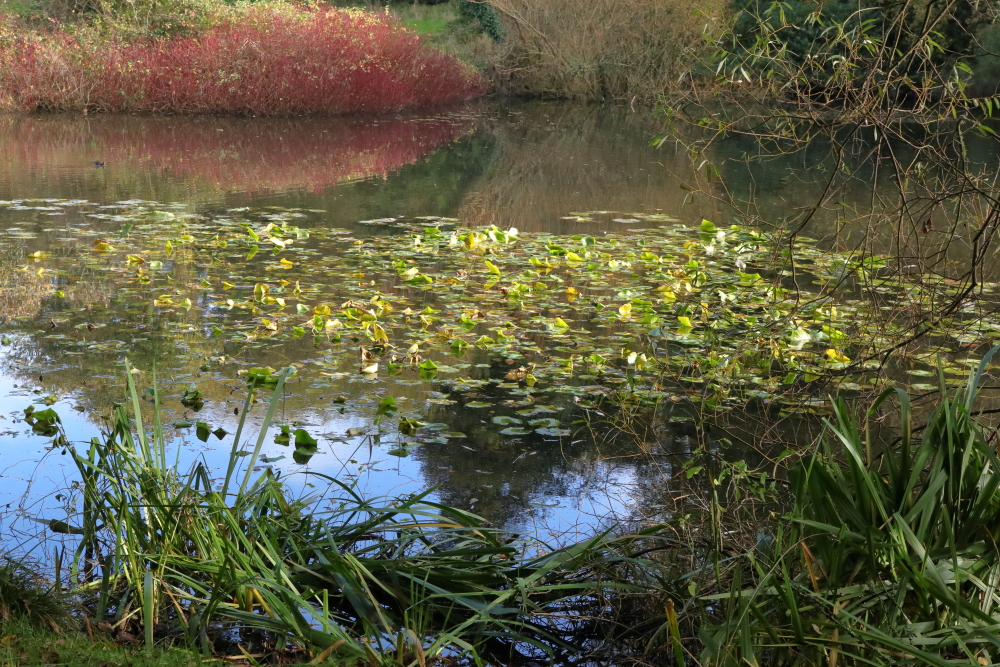
It was a lovely day, I sat for a while watching the ducks and moorhens on the amphitheatre pond before heading home.
 Jim's Camellias
Wonderful. Thankyou.
David Jones
LikeLike